
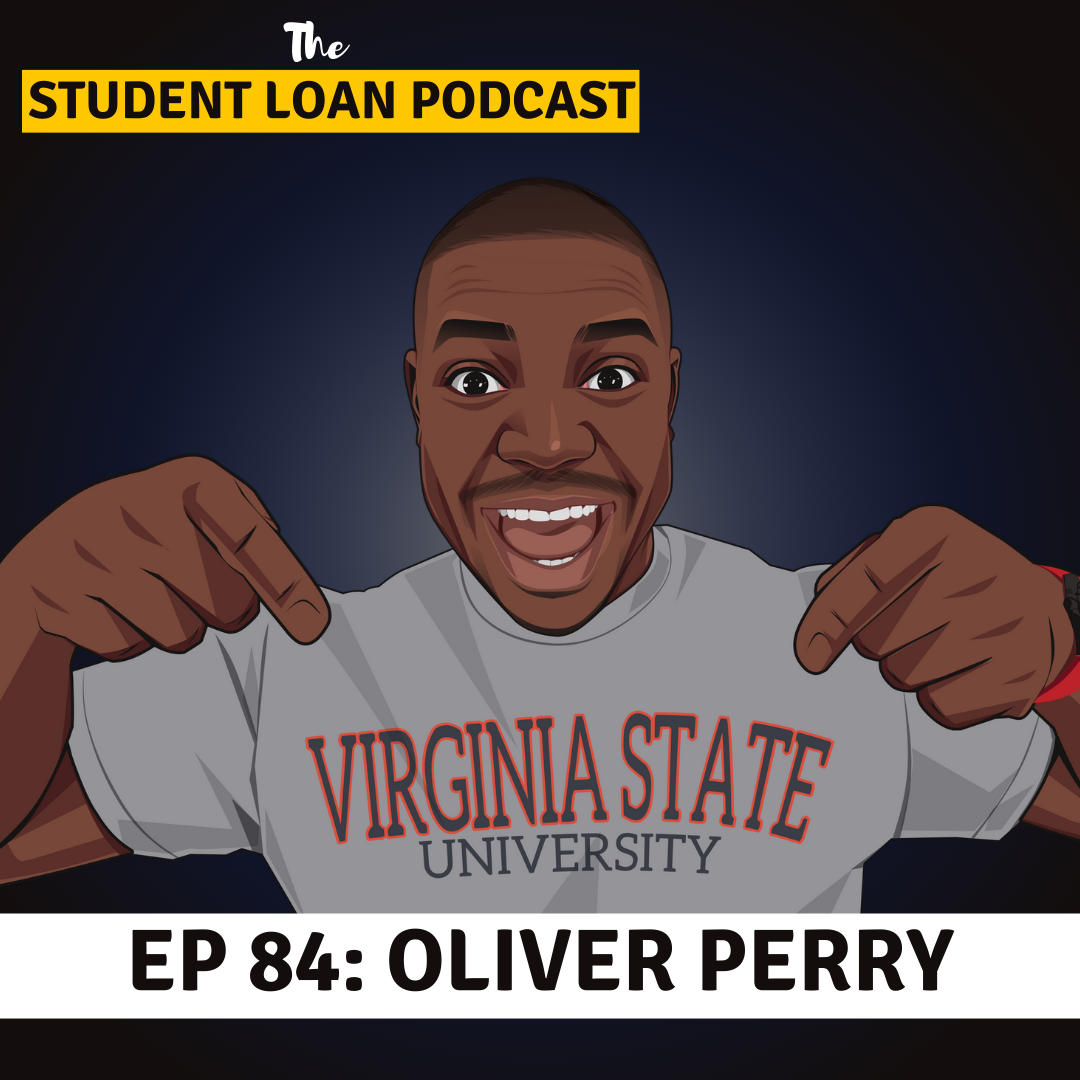

O
liver Perry (@theoliverperry), host of The Oliver Perry Show, shares how he paid off over $40,000 in student loans. Oliver has an interesting journey that many of you can relate to or may find inspiration in hearing. We take a dive into what his mindset was throughout the different periods of his life and his student loan debt payoff journey. It’s not always sunshine and rainbows but the mindset that you have as you make your way through your debt payoff journey is what will set you up for success in paying off your student loans.
Outside of hosting The Oliver Perry show, being a husband & father, and serving as a military officer, Oliver likes to spend his time investing in real estate, playing golf in foreign countries, cracking jokes, and spending way too much money on MTG.
THIS EPISODE COVERS:
- How he paid off over $40K in student loans;
- What his initial motivation was when he joined the US military and how it relates to college;
- The hustle mindset he had to adopt to meet the minimum student loan payments after graduation; and
- much, much more…
CONNECT WITH OLIVER PERRY
- YouTube – @TheOliverPerry
- Instagram – @TheOliverPerry
- Podcast – Real Estate from the Foxhole
Enjoying the show? Leave us a rating and review. Every comment helps! Drop in your IG handle so we can thank you personally!
[00:00:00] Announcer: At the end of the day, nobody's going to ask you, hey, how many mistakes did you make? They're going to say, the end result, and the end result is going to be your success, having that Sally Mae paperwork saying you're clear or Penny Mac or whoever you borrowed money from in your hand and you're like, yeah, I'm out here in these streets and I'm free of this loan.
[00:00:27] Announcer: Welcome to the Student Loan Podcast. Here, you'll find practical advice on tackling student loan debt, paying down your higher education expenses, and inspiring stories about paying off student loans. We're your hosts, Daphne Vanessa...
[00:00:40] Shamil Rodriguez: And Shamil Rodriguez.
[00:00:42] Announcer: Please rate, review, and subscribe to the Student Loan Podcast by visiting the Student Loan Podcast on Apple Podcast or wherever you find your podcasts. This is not professional advice, and we speak from our own personal views and opinions. The Student Loan Podcast is brought to you by Start New, where you can serve your community and get rewarded with tuition and student loan payments. To check out if Start New is on your campus, visit startnew.com.
[00:01:08] Shamil Rodriguez: All right everyone, welcome to another episode of the Student Loan Podcast. This is an interesting episode that we're going to have today actually. Got a good friend on who, paid, I don't know what buffoonery we're going to get into it today. But we're going to be sharing how he paid off his student loan debt journey, him and his wife paid off their student loan debt together. So we're really looking forward to that, starting off the new year with some new inspiration, and wanted to make sure we brought some of that to you today. So with that being said, let's bring on the host of the Oliver Perry Show.
[00:01:54] Oliver Perry: Hey everybody, I'm Oliver Perry. James Oliver Perry to be exact, but please just call me Ollie. I am a US Army officer. A major in the US Army, been in for the last 16, 17 years. I'm also the host on the Oliver Perry Show, which is a YouTube channel, as well, I had a podcast by the same name which is now newly been minted as Real Estate From the Foxhole, focused on helping military, government workers and anybody employed out there who feels like they're in those golden handcuffs and want to use real estate to get out of it. So I'm, I'm here to, to talk to Shamil and I'm looking forward to this discussion. Let's go, Shamil.
[00:02:37] Shamil Rodriguez: All right, let's do it, let's do it. All right, so let's get into one, your background. Let's talk about you said you, you joined the military we basically when you were 15, if you said you've been it for almost 20 years already. So...
[00:02:51] Oliver Perry: Woah, wait a second. No, man, I'm 40. Listen, it was... It was, I was in college. So I went to college of course, I went to Virginia State University. Shout out to the Trojans. And I went to school there and then decided, hey, I'm going to get into the ROTC program. Signed up for the ROTC program, got as in as a part of that program and started doing the contract thing, so I was getting paid once a week, not once a week, once a month, and I was blowing that money, which was amazing and absolutely horrible at the same time. And then now, you know, we are where we are now. 2005 I got out of Virginia State, graduated by the skin of my teeth and you know, now we're, we're in the US Army and we're traveling the world and doing great things.
[00:03:52] Shamil Rodriguez: So, so quick, let me back it up there because I'm curious. Did student loans or the cost of college play a role in joining ROTC at all, or was it purely for for the love of God and country?
[00:04:06] Oliver Perry: Yes, it did. No, no, no. It was 100% money oriented at the time. I had went to college so I actually got a scholarship to play tennis. So I played tennis, partial scholarship, so it wasn't enough to cover everything, and at the time you know, 40k, 30-40k, 50k was a lot of money in my parents eyes as far as that time. Father was still... was still in the Navy working as a... he was a chief in the Navy and my mother was working at USAA insurance. Shout out to USAA and the US Navy. And at the time my father told me, "Hey, listen, I, I don't know how I'm going to be able to afford all this. We got a lot of stuff happening, you got your two sisters, I need you to figure something out. We're going to try and get you to this tennis scholarship." So we went and did the grind for the tennis, partial tennis scholarship. I wasn't great. I wasn't bad, but I wasn't amazing either. And then while I was there, I said, "You know what? I would like some money once a month." And you know another way I can just get into the Army and use the Army as a step stool to become an animator, which is at the time what I wanted to do. So here we are now. I'm not an animator, but we sure enough did pay off those loans.
[00:05:43] Shamil Rodriguez: There you go, there you go. You got one of those got done.
[00:05:46] Oliver Perry: Right, right. You got to check your priorities.
[00:05:49] Shamil Rodriguez: Exactly, exactly. So a good question you, you sparked some interesting the idea that your father was having that conversation with you like say like, "Hey, this is what the trajectory is going to look like." So was that like just normal? Is that is that something that came easy for you guys? I'm just curious to see like that dynamic because often times parents are involved in one way or another. But on the other side of that coin, there are a lot of people that don't have advice or any guidance, or anybody who went to school before them. So I guess what was your experience and how was that like to have that conversation?
[00:06:29] Oliver Perry: Mmm okay. So for me, I think I lucked up in that regard. My father had gone to Johnson C. Smith as well as my mother. Both of them had gone there. Of course my father clearly didn't graduate, he actually went and joined the Navy at the time. So he had some understanding of what it was like to go to college, particularly at Historically black colleges and universities (HBCU). As well go there and not have all things you needed because his father had left his family, he had walked out um and his mother had been a single mom raising himself and his sister um for some time. So he had a different perspective and he was hood. I mean my father was ratchet as it comes at the time, as a young man. My God, my dad was... He's cool as all get out but like, he, he tells me his stories of stuff they were doing, and not that they were robbing people or doing anything like that, but normal kid on on the street stuff with very little parental guidance, fighting and, and doing stuff like that. So he, um, he gave me that background and that, he taught me all that stuff in regards to hey, this is college, this what college is like, this is a way to get you in, and partly started to I think partly started teaching me tennis because he wanted not just a relationship with me but also an outlet for me to be able to, to make enough money. Because he saw clearly my grades weren't amazing. I wasn't about to get into Harvard or anything like that. Nothing against Virginia State, but you know the, the standards at least for getting in are a little bit higher.
[00:08:14] Shamil Rodriguez: Well not everyone's getting into Harvard, let's not... Exactly.
[00:08:16] Oliver Perry: Exactly, right. Shoot, I mean be honest, not everybody's getting to Virginia State either, right? So, there you know, the standards for each college is, is different. But it also I think comes down to the effort you put in. So at that time, my father was doing a lot in that regard, looking up stuff, kind of educating me on hey, maybe you should think about this, maybe you should think about an HBCU, because that's where he really wanted me to do was to go to an HBCU. So, that's exactly why I ended up doing, as well as, you know, the military part of it.
[00:08:43] Shamil Rodriguez: Okay, so he, he took that active role in giving you that that guidance. Absolutely. No that is, that's good because I'm just trying to think about the idea of like, all right, so let's go back onto it. So, at that point you're, you're um in school, um you're playing tennis, uh who are you playing? So you're playing tennis with the school, you're in school, you decided to join J- or ROTC. Um, did you decide, like did you have to stop tennis or did you have to continue tennis while doing that at the, at the same time?
[00:09:16] Oliver Perry: No. So ROTC was at the... Our ROTC program it was set up just like any other class. So it was laid out for my entire schedule of the day. I would go to this class, this class, this class. Normally at the end of the day I was going to the ROTC um program. Now, they had different classes and they had their own building just like any other um school has their specific arts building or business building, they had the ROTC building. So, excuse me, good grief. There you go, okay. So I went to the ROTC building and would do my class there or if we had class during the day, I'd go to that class. Um whenever we had training, I'd do that. Tennis was always separate, so I would go to tennis practice or I would go to whatever matches, and either way depending on what was going on, I would let the other side know what was happening. So if I had to do something for tennis, I'd let ROTC happen, if I had to do something for ROTC, I would let the tennis coach know, "Hey, I'm going to be out of town or I'm going to be doing this, this and this, I won't be able to make practice." So that normally worked pretty well.
[00:10:20] Shamil Rodriguez: Okay. And you know what? I just realized that since you and I both know the military... Yeah. We just started as rolling into what ROTC is. Uh so just in case for people who don't know what ROTC is, uh it's a source of let's say creating, I don't know if that's the word I want to use, but I guess uh generating officers for the military. Uh so depending on which one it is, it could be for the Army, it could be for the Navy, it could be for the Marines, right? I believe. Um they, I haven't met anybody who's been from that source of commissioning. But, uh the idea is that you go to school, um and actually, you know what? JP, do you want to break it up?
[00:11:04] Oliver Perry: Yes. All right. So, you go to school, um ROTC is, and I cannot remember for my life what ROTC actually stands for, but as Shamil said, it's more of a, almost like a recruiting tool for um us bringing, the military bringing in officers into the military, right? So what happens is the student goes to school, he, she, they, them go to school, they attend courses as any normal college student would. They graduate with their degree, they also graduate from the ROTC program and when they do, they're commissioned directly into the US military. In some form of capacity, sometimes it's a National Guard move, sometimes it's a reserve move, sometimes it's a active component move. That is all decided there in the program, during around the last 2 years or so is when that starts to kind of flush itself out. Um so that is how a lot of the officers you'll see, they're not just going to the West Points and the, and the Naval Academy, they're also going to ROTC programs at these separate schools and going through kind of the same process, just not strictly military oriented because they're normally going to a regular college, they're not going to a military college necessarily.
[00:12:19] Shamil Rodriguez: No that's a good point and a lot of people will use that as a benefit to either pay for school, um or at least in terms of like that motivation um like you were sharing. Um earlier, when you initially joined. Uh but, you so you still had student loans even though you were part of the ROTC program.
[00:12:38] Oliver Perry: Correct, still had student loans because I was part of the ROTC program. ROTC would provide, um they were providing like a month-to-month check, which was a stipend. Okay. But it wasn't in the contract for me to have my student, my school cl- school paid for as a whole. Now, there are other students that are in the ROTC program and each student is different that have that in their contract. For me, that wasn't the case because I joined in the last 2 years as opposed to joining at the very beginning of the program when I got to college. Um because at the time I wasn't really sure if I wanted to do the Army thing, and it hadn't even really crossed my mind. Exactly. And it hadn't even really crossed my mind, so I was just doing whatever was going to work for me at the time.
[00:13:22] Shamil Rodriguez: That's fair, that's fair. No that's good to and I think it's good just uh even though we went down that alley way or that rabbit hole, it was good to share that perspective uh because if you're looking, especially on the Student Loan Podcast, if you're looking for ways to pay for school, uh one that you may want to consider is ROTC if your college or university has ROTC on their campus. So, good to know, but let's get back to your story. Let's do it. Um, all right. So, so now you're, you're um in school, uh you're playing tennis, uh who are you playing? So you're playing tennis with the school, you're in school, you decided to join J- or ROTC. Um, did you decide, like did you have to stop tennis or did you have to continue tennis while doing that at the, at the same time?
[00:14:04] Oliver Perry: Okay, so graduated from Virginia State University in 2005. I left Virginia State and moved back home. Um, and if, as I think about it, it was an adventure in itself. So I moved back home, I'm living with my parents, but I'm also working at a reserve, in a reserve unit at the Joint Forces Command. At the time they were there, at Norfolk Naval Base. My father again was Navy, so he knew kind of where to go and additionally to that, because of our church family, I had met a lot of folks who are already in the military and were connected in the right places, so they kind of um what they call it, nepotism? They got me the nepotism hookup into, we keep it real here on the Student Loan Podcast. You know, 100% honesty, you know, a little bit of nepotism came in, but the right people knew them so they said, "Hey, go talk to whoever it was, Admiral Michael or whatever his name might have been, um but hey go talk to him, he's going to tell you what to do." And sure enough I ended up in a unit that was at Joint Forces Naval Base and I worked there for the next 3 or 4 years. In that time frame, I was paying off some of my student loan of course as we go along, and we'll get in a little bit deeper to that. Um, but it didn't really take off until I ended up leaving there and going to Atlanta and getting a full-time Army job as what we call a ADOS, Active Duty um Active Duty Support, I think is what it is. And I was at ADOS at the first Army headquarters, which at the time was in Atlanta, Georgia. Um and now has moved to Rock Island, so that's where I was there for quite a while.
[00:15:58] Shamil Rodriguez: Okay, so then you went, all right, so you went home, uh got yourself settled, then you found a full-time job in Atlanta, uh still within the military.
[00:16:07] Oliver Perry: Well, I went to Atlanta first and then found the full-time job. That was, yeah, I was, I had like six jobs at the time in Atlanta. Hey, we're making it work. You got to do what you got to do.
[00:16:21] Shamil Rodriguez: Pit stop on your journey, that's all. It's just one Exactly. There you go. Pit stop.
[00:16:25] Shamil Rodriguez: Um, all right. So then now you're, now you're there, have you gotten married yet? Because I know we're going to we're going to bring your wife's student loans into this at some point, too. So, where, where are you, where are we in your journey at this point with your student loans?
[00:16:38] Oliver Perry: So, at this point, I was still single. I was still paying off the student loans. Um Minimum payments at this point or just or were you just... Minimum, it was still minimum payments. I was, I was doing enough to get by without really hurting my pocket. So I think around this time, I had reached um probably 5,000 less because I was just doing, you know, as much as I could when I could, just as long as I was hitting that number because I didn't want anything to happen credit wise later on down the road. So, and you know, my father stayed on my back as well, he didn't really play around with that. So, um that's how that ended up doing. Now, I didn't get married until I ended up moving from there and moving to Hawaii. So, not too long after that, I got stationed in Hawaii, um working in... Where was I working? I was working in um 311th... No. Yeah, 311th, sorry, the the units that I were in, the name, the numbers all the same. So 311th was the Hawaiian command, command I worked for in Hawaii. Okay. Now, I I got married in that time frame and moved my wife out, and I came in and the good thing with there was that she had paid for the majority of hers already before she came into the relationship.
[00:18:04] Shamil Rodriguez: Okay. All right, so... So, that was, you know, that was a bonus. It was something I should have asked when we started dating, but I didn't, but whatever. Yeah. I mean hey, we live and learn. Right. It was an extra 5k debt, which was no big deal because she had already done a lot of the work. On top of, at the time, 25-20,000 dollars, whatever it might be at that time, um onto mine. And that's when things really started changing because now I was in Hawaii, the number has gone up as far as my payment, I had been promoted a few times, and then additionally, she had a different financial understanding than I had. I didn't really wasn't really working well with money at the time, didn't really understand all I was doing, I was just kind of living life paycheck to paycheck, and she came in and, and of course slapped me over the back of the head and changed that game up entirely.
[00:18:52] Shamil Rodriguez: So, the so now I'm curious let's, let's go back to um the idea because you're not you're not alone in the idea that, you know, people are just trying to cobble together whatever they can to make sure they're just getting those minimum payments done. Correct. So let's, before we get into how things sped up for you in Hawaii, let's talk about the mindset or what your journey was like when you were trying to make things happen at that time, because there are a lot of people out there that are in that position right now.
[00:19:23] Oliver Perry: Okay. So my mindset at that time was make it happen, which is to be honest, at this point, I think still is my mindset on most things, but in this instance it was I had moved to Atlanta, I didn't have a home. I was living with, at the time, um my girlfriend or ex-girlfriend's brother, which was a whole debacle by itself, but I was living with them and I was doing three jobs, I was working at Walmart, I was working at a um of course I was doing my reserve unit stuff, and I was working at a Toys "R" Us I think at the time as well. So I would do all this constantly, I'm just grinding, grinding, grinding. Walmart for the majority of the night, and then the majority of the day I was at the Toys "R" Us, in between there, whenever I had to go to the unit to do our drill, I would go and do our drill work. You know, the 1 week a month, 2 weeks a year, that kind of thing. Um and my thought process was I don't really have much other choice, I don't want to go home. So what do I do to not go home? All right, well, I'm going to go and make the money. I'm going to give um the guy who's hosting me at this point what I can, which wasn't really much of anything, I gave him more company to be honest than than funding. He would look out as much as he could, of course, at the time he did, thank God. And then I ended up just saying, "All right, cool, well, I'm going to pay this amount, this amount, this amount." And I just kept putting that little bit towards it, putting that little bit towards it. So it was the whole thought process of at the time, 40,000, 30,000 dollars, that's a lot of money. For me, at least. It was all about eating the elephant one small bit at a time. So that's what ended up becoming my mentality, okay, I got to knock down this big goal, I got to go piece by piece by piece because I don't I don't know how else to do it, and then, you know, sure there was some times I was hitting the ramen noodles relatively hard, or I was just able to drink water for an entire month, nothing else but water because it was the only thing that was free, and it was Georgia tap, which is probably not the healthiest looking back, but you know, you got to do what you got to do at the time. You're still here, you're still here. Exactly. Right. Exactly, exactly. But that was, that was mainly how my mindset worked and my thought process behind the whole thing.
[00:22:04] Shamil Rodriguez: Mmm okay. No, it's good, it's good to hear, thank you for sharing that because uh you're not alone in that experience, right? And whoever's listening, you're not alone in that experience either, and as you're going to hear as we go through this story, uh JP was not that, it sometimes it's easy to lose focus on the idea that we have guests on the show that paid off their student loans, and they're just there already. So like, oh yeah, they just magically made that happen. And I'm not saying that's the case because we we have many episodes where people have paid off their student loans and shared their their progress through their journey. But I'm happy you shared that so that we people can understand, hey, you have this make it happen mentality, you had to make sure like whatever you could cobble together, you got it done. Uh, you know, you still had grace from other people around you that to support you whenever they could. So it, you know, it wasn't, uh I really hope that whoever's out there, if you're in that position right now, just know that you can be debt free before you know it, but you got to take it one piece at a time.
[00:23:10] Oliver Perry: One at a time, absolutely. Absolutely.
[00:30:46] Shamil Rodriguez: All right, so let's let's go to Hawaii, because Hawaii has great weather all the time, right? Oh yeah, yeah, yeah it does. Yes it does. So now you're in Hawaii, you're married, uh your wife, um so you said something interesting that I thought was um, because you know when I've met you now you're you're in a different phase in your life, so I know that you already have this money mindset already in place and you can tell you've been doing it for quite some time. I've seen that that check-in, that that idea you know, we've had that had those discussions. Uh so, what else did you want to share when it came to your student loan debt payoff journey? Like, did you guys celebrate? You know, like what was the, when you like got that final, that final letter from Sally Mae saying like, "You're done, you're free now." How did you celebrate? Yeah, do you remember that, do you remember that moment?
[00:24:08] Oliver Perry: I'm pretty sure I know how we celebrated, but I'm not sure that's the right rating for this particular show. Got it, I remember. I have to, I have to click if this is uh safe for children when I upload this. Rated R? Yeah, no, we're not, yeah, we won't go into that celebration, but yeah, we did, we did celebrate, um we just kind of, and it was, you know, just a regular normal celebration in that sense, but it just, you know, we went on to the next day, the next day and hey, we got to go towards the next goal, which is maybe something we have to work on and continue to work on is celebrating those W's. Mm-hmm. And not just kind of throwing them to the side.
[00:24:45] Shamil Rodriguez: Okay, yeah. Being there in the moment. Um, no, I'm I'm happy that you shared that because we're going to have another couple that that came on our radar that is going to be an episode on this show, the way we found them is because they were celebrating together um and they posted like a reel or something like that online, it was like, oh man, we got to share these stories. So, um, I'm I'm happy to hear that. So, so before we before we wrap up, I wanted to ask you how can people connect with you because you want to help people get into real estate, but to get into real estate you got to have good credit like you had mentioned before, or you know you got to have good money habits if you want to grow that portfolio in some way or another. Um, so, uh, you know talk to us a little bit about that and then and then we'll wrap up.
[00:25:34] Oliver Perry: Okay, sounds good. So, for those of you who want to get a hold of me or reach out or see what's going on, you can go on to any of your podcast platforms and look up Real Estate From the Foxhole. I'm a host of that show. Or you can go on YouTube, which is probably my preference that you go on the YouTube, The Oliver Perry Show. There's a lot more content when it comes to real estate, um from fun content, some behind the st- st- some behind the scenes stuff, the daily things that I'm doing to get to 625 doors, which is currently the goal to reach in from real estate for me within the next 4 years. So if that's something you're interested in, you want to learn, that's the place to go because you'll learn step-by-step as I'm figuring out and smashing my head up against the wall trying to get there, you'll be able to avoid those mistakes and take those lessons and literally mirror what I'm doing to get to your first million through the real estate process. Um so you can reach me in those places, or you can just hit me on IG @theoliverperry and those are probably the best ways to get a hold of me.
[00:26:42] Shamil Rodriguez: All right, fantastic, fantastic. So one thing I want you to wrap up on, and I want you to give this last message here, so for anybody who's out there who's struggling with their student loans uh in any way or another, what's the message that you want to give to them uh speaking one-on-one with whoever's out there right now?
[00:27:03] Oliver Perry: Got it. Uh my advice to you, for you listening and for you watching, is be okay with failing. You're going to make mistakes along this journey to pay off the student loan. Matter of fact, you're going to make mistakes along the journey to do anything that you want to do in the long term. The difference between those who succeed and those who don't is those who get up and do it again. There's a reason Tom Brady's 40 however many years old and kept getting up from getting tackled. There's a reason Michael Jordan got cut off the basketball team and came back at UNC and ended up dominating the sport. There's a reason Kobe Bryant didn't win every single game and he would come back and destroy teams afterwards. There's a reason for all these things and the same would go for you. There's a reason that you're going to have a mistake, you're going to have an issue. The Most High might be putting you through a process that you have to understand where your mistake is. Take a second, breathe, look at what you messed up on, get up and go after it again. At the end of the day, nobody's going to ask you, hey, how many mistakes did you make? They're going to say the end result, and the end result is going to be your success, having that Sally Mae paperwork saying you're clear or Penny Mac or whoever you borrowed money from, is in your hand and you're like, yeah, I'm out here in these streets and I'm free of this loan. Do not be worried about making mistakes and having those issues, stay focused, stay driven and keep going.
[00:28:44] Shamil Rodriguez: Absolutely, love it, love it. All right, guys, everybody so you know to find him, The Oliver Perry Show on YouTube is where you should go first. Uh, Real Estate From the Foxhole if you want to listen to the podcast, uh and if you want just message him on Instagram, he's great with advice uh as you can tell here on the show. Uh but for more information on today's episode and links will be in the show notes, visit thestudentloanpodcast.com/episode84. That's thestudentloanpodcast.com/episode84. All right, thanks for joining the show.
[00:29:21] Oliver Perry: My pleasure. Wait, was that, was that what I was supposed to do, that part? I realized that was uh for for for you and then I realized I was like you know what, that sounded like it was for everybody else. All right, everybody, we'll see you next week. Later, man.
Sign up to receive email updates
Enter your name and email address below and I'll send you periodic updates about the podcast.


0 Comments